Full-site WCAG scanning for teams and agents.
Purpose-built for compliance and marketing teams. Designed to prove your site works.
Compliance isn't a snapshot. It's a habit.
Observe
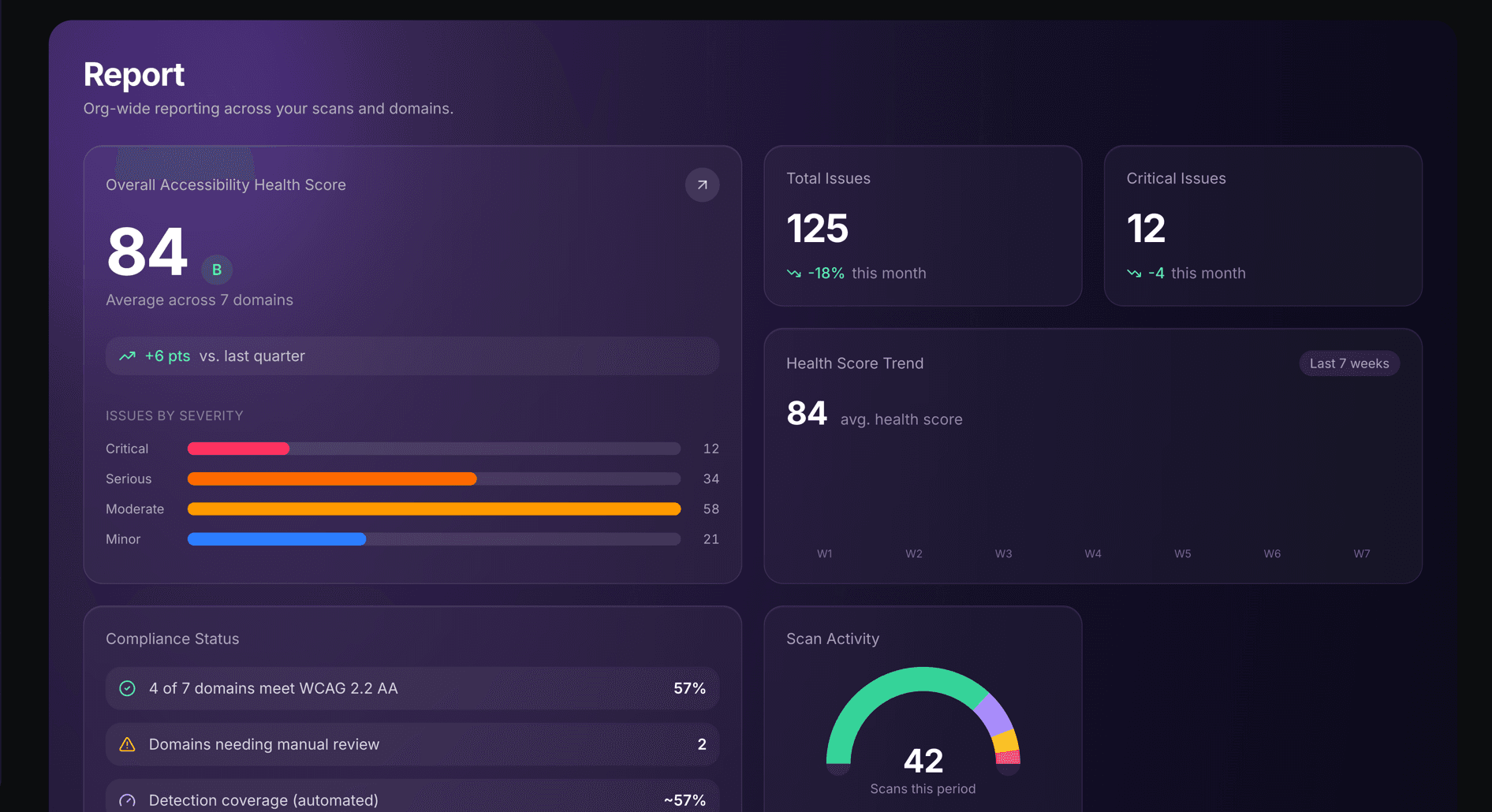
See where you stand, at every level.
One report, two altitudes. Leadership gets a birds-eye view of compliance risk. Managers, designers, and engineers get the exact issue, on the exact page, with what to fix.
Act
Know exactly what to fix, and where.
No raw data dump. Every finding is a clear, assignable fix: the page, the element, the rule it violates, and what "fixed" looks like.
Improve
Catch regressions before they cost you.
Sites drift out of compliance quietly. A new campaign page ships and breaks something nobody notices, but recurring scans catch it the moment it happens.
Scan
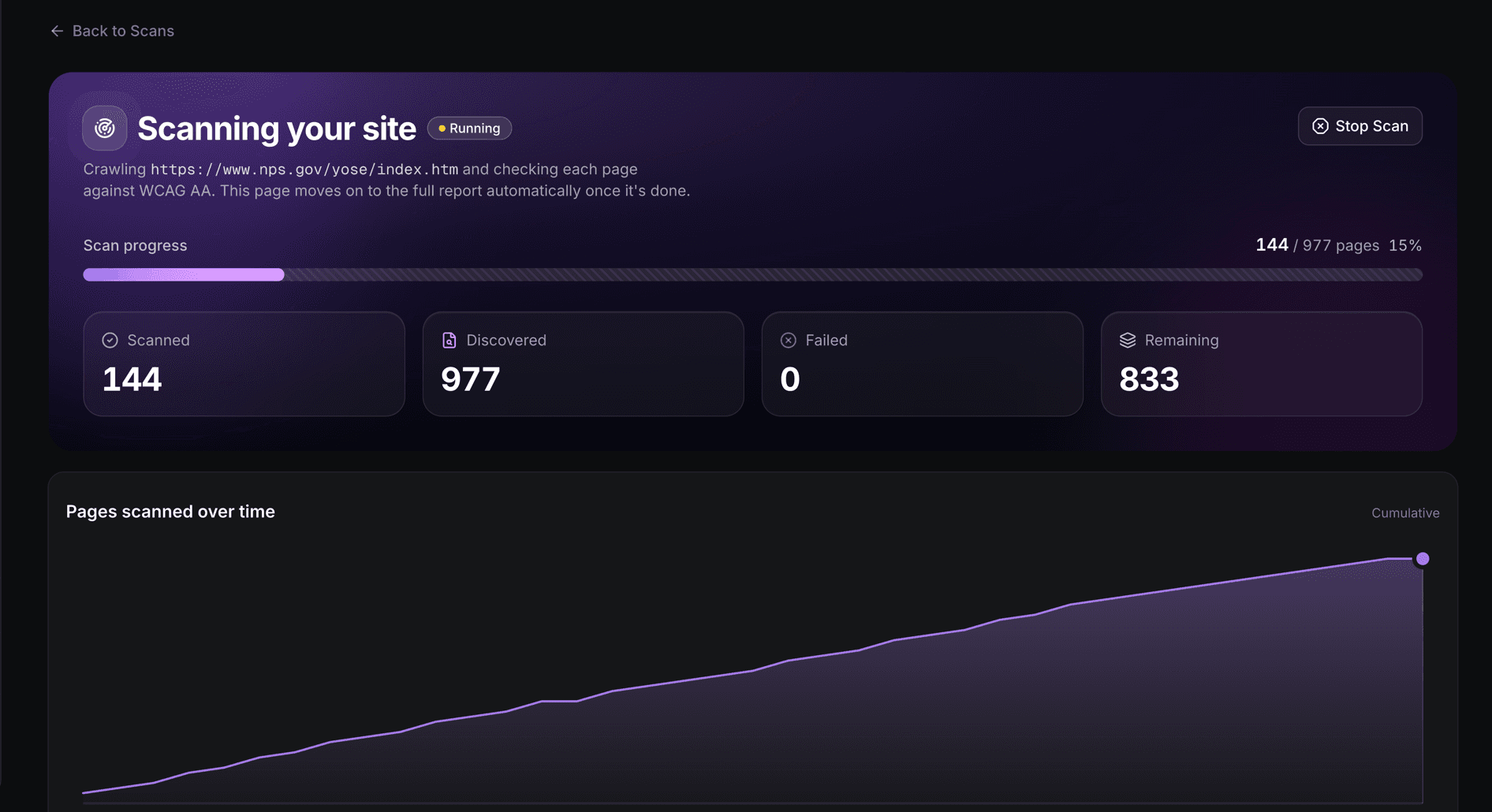
Log in. Drop a URL. Press scan.
No crawl rules to configure, no sitemap to upload. TrustScans finds every page on its own and starts scanning immediately. You'll know the moment it's done.
Report
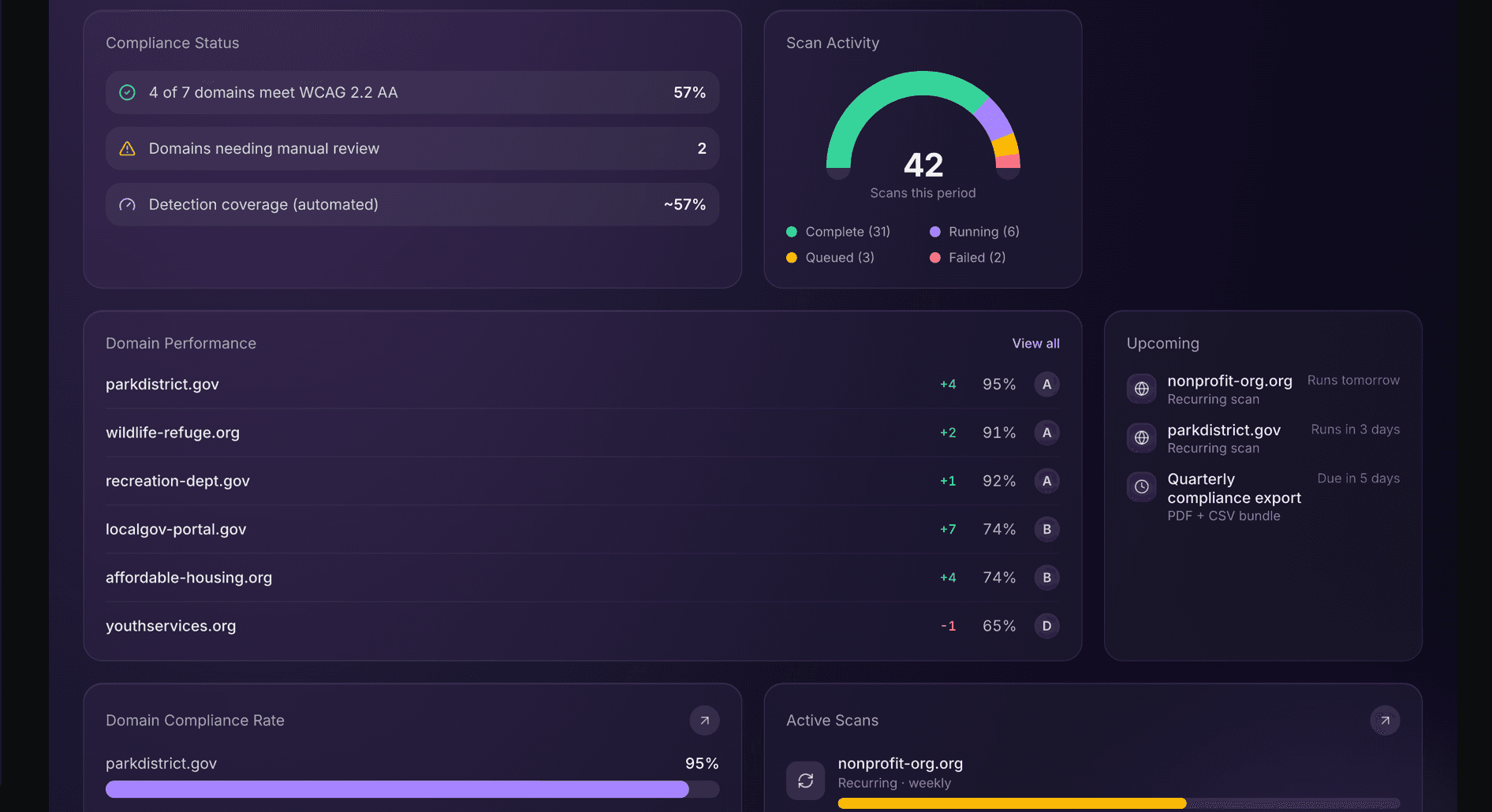
One report. Every team reads it differently.
A director opens it and sees a grade. An engineer opens the same report and sees the exact element, the exact rule, and the fix. No translation layer, no second document.
Track
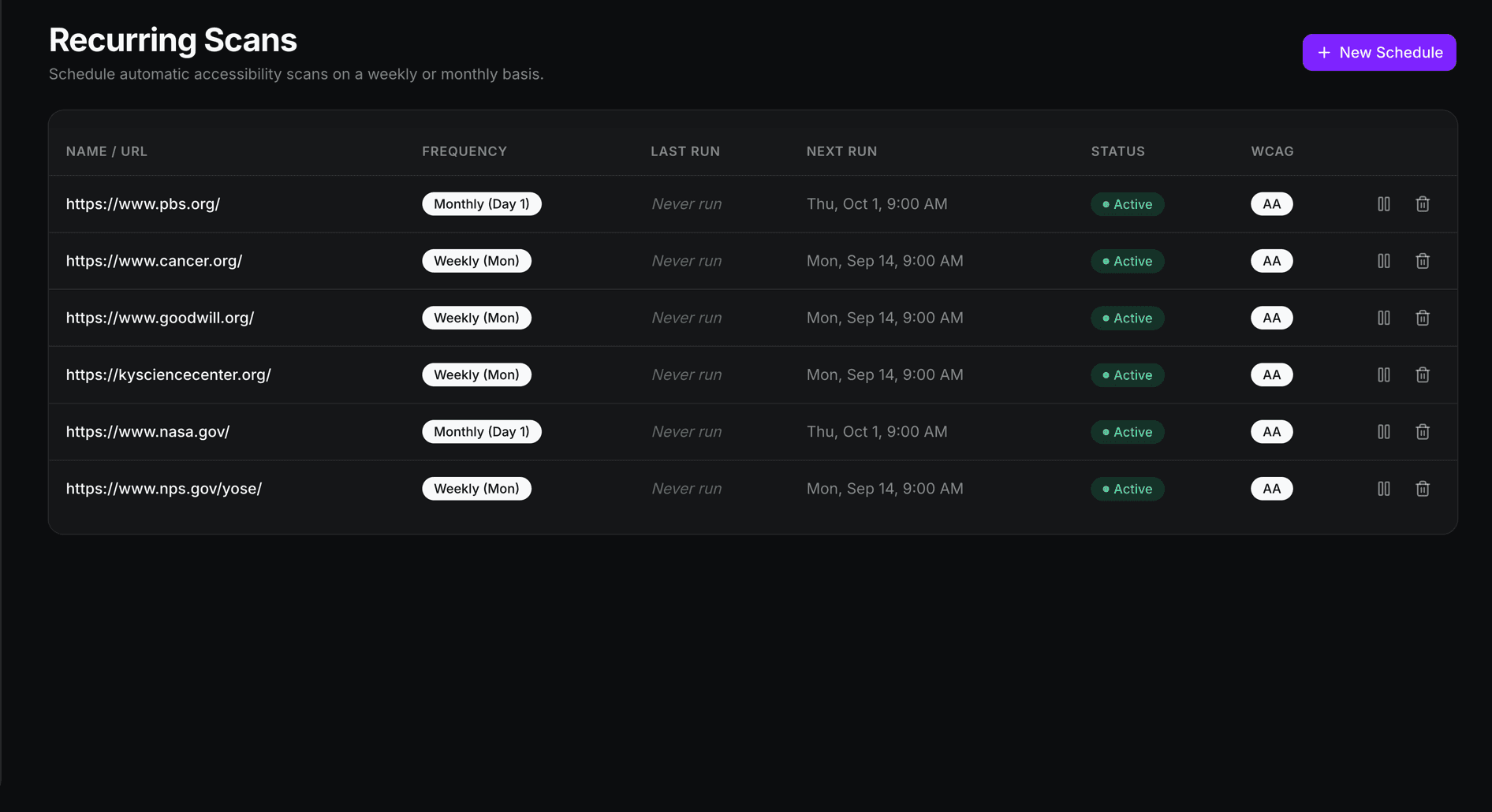
Sites don't fail compliance once. They drift.
Set scans to run weekly or monthly and TrustScans tracks every result over time, so when a new campaign page quietly breaks something, you find out in days, not at your next audit.
Why we built this
We were the client, too, stuck between free tools that only check one page at a time and paid tools that bury the answer in reports no one can act on.
As a web agency, we needed to know how compliant the sites we built actually were. So we built the tool we wished existed: one that scans the whole site and explains what it finds in a way that doesn't cost more time and money to even understand.
No overlay, ever
TrustScans never puts a widget or script on your site. It tells your team what to fix, and helps them fix it in the code.
Overlays try to change pages in each visitor's browser. We think fixes belong in the source, where they reach everyone. See how TrustScans compares with accessiBe, UserWay, AudioEye, EqualWeb and Siteimprove, with a source for every claim.
Questions
Things compliance and procurement actually ask.
01Does TrustScans produce a VPAT or ACR?
Our reports are VPAT-ready evidence: every finding is tagged with its WCAG success criterion, timestamped, and reproduced with a screenshot. Today, your team fills out the VPAT document using our report. We’re shipping a VPAT-formatted export that groups findings by criterion with a conformance column built-in.
02Which regulations does scanning cover?
Scans run against WCAG 2.2 Level A, AA, and AAA, which is backward compatible with every regulation that references 2.0 or 2.1, including ADA Title II/III, Section 508, EN 301 549, AODA, and the European Accessibility Act. Pick the level you audit against on each scan; reports tag each violation with its criterion for easy evidence mapping.
03Can you sign a DPA or complete a security questionnaire?
Yes. We provide custom Data Processing Agreements, SIG/CAIQ responses, and tenant-isolation documentation on request for government and enterprise prospects. Book a demo and the paperwork runs in parallel with the evaluation.
04Where is data stored and how is it isolated?
Hosted on Vercel with data in Supabase (Postgres), both operating under independently audited SOC 2 Type II controls. Every row is scoped to an organization via Postgres Row-Level Security; one customer’s scans cannot be read by another. TLS in transit, encryption at rest.
05How many pages can you scan?
You set the maximum per scan. We default to 500 pages and have run scans across 10,000+ pages. Full-site coverage typically completes in minutes, even for large properties.
06Does it work on React, Angular, and JavaScript-heavy sites?
Yes. Every page is loaded in a real browser, exactly the way your visitors see it. Single-page apps, client-side routing, and dynamic content are scanned the same way a user experiences them, so the evidence you get reflects what actually renders, not a stripped-down crawl of raw HTML.
07What does it cost?
TrustScans has a free tier for a single site and one seat, no credit card required. Basic starts at $19/mo for a single, larger site. Team starts at $49/mo for agencies and teams managing multiple sites with unlimited seats. Enterprise pricing is custom and handled through a demo. See the pricing page for the full breakdown.
Start
Find out where you stand. Start free.
Scan your first site in minutes, no card required. Need a plan for your whole client roster? Talk to us.